

NOTICE
This website is in the midst of its transition, marking a new chapter beyond the alyssawalsh.com site that has carried my work for seven years. You may find portions still taking shape.
Unfinished Greece
Project Overview
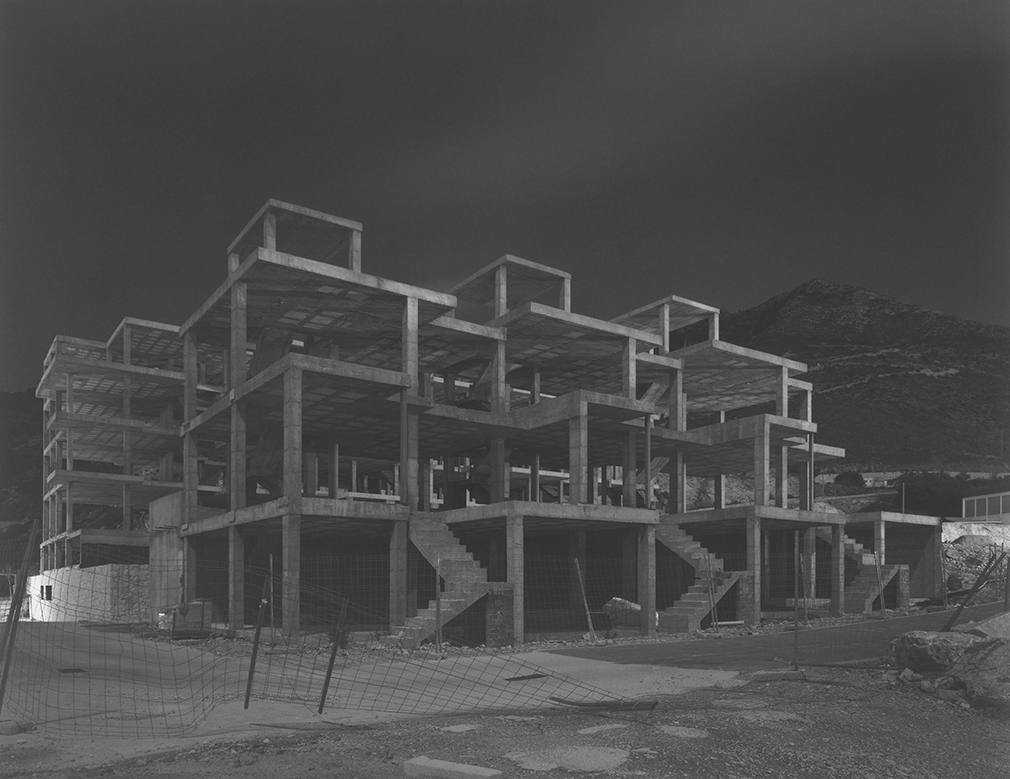
Unfinished Greece is an architectural history and documentation project examining the widespread presence of incomplete reinforced concrete buildings across Greece. These structures, commonly encountered in both urban and rural contexts, occupy a prolonged state between construction and abandonment. Their existence is shaped by intergenerational building practices, inheritance law, economic fluctuation, and culturally embedded attitudes towards permanence, ownership, and future occupation.
Rather than treating these buildings as architectural failures, the project frames incompleteness as a distinct and culturally legible condition. The unfinished structure is understood not as an anomaly, but as an established architectural mode within the Greek built environment.
Cultural and Historical Context
Following the Second World War, reinforced concrete became the dominant material of domestic construction in Greece, enabling incremental and owner-led building over extended timeframes. Legal and economic structures encouraged construction to proceed in stages, often across generations, resulting in buildings designed to accommodate future extension or completion.
Within this context, architectural incompleteness emerged not as a temporary disruption but as a normalised and anticipated condition. The unfinished building became a stable presence within the landscape, reflecting long-term familial planning rather than immediate occupation.
The Skeletal Structure
Architecture Without Closure
At the centre of the project is the exposed concrete frame, or skeletal structure, which defines the architectural language of incompleteness.
Characterised by open slabs, projecting reinforcement, and absent infill, these buildings present a form that is structurally resolved yet programmatically indeterminate. The frame operates as a spatial and material framework awaiting future inhabitation rather than a finished architectural object.
This condition challenges dominant Western architectural narratives that prioritise completion, finality, and visual resolution. Instead, the skeletal structure embodies continuity, expectation, and deferred use.
Project Position and Ongoing Research
Future development may include expanded photographic surveys, site specific case studies, and further engagement with adaptive reuse and heritage discourse. The project remains intentionally open, reflecting the subject matter it examines.
 Alyssa Denise Walsh