

HERITAGE HOMES
Project Overview
Heritage Homes is an independent, self-initiated architectural research and design project exploring how new housing settlements in the United Kingdom might be conceived through the reinterpretation of historic architectural typologies, construction logics, and settlement patterns.
Rather than treating heritage as a matter of preservation alone, the project positions history as an active design resource, capable of informing contemporary housing at scale. The work proposes that meaningful new housing must be rooted in architectural lineage, material intelligence, and social precedent, rather than relying on abstracted modern models disconnected from place and memory.
Heritage Homes is conceived as a new town framework composed of multiple housing typologies, each derived from specific historical references and environmental conditions, yet unified by a shared architectural philosophy.
Contemporary Context
The project emerges in response to the ongoing housing crisis in Britain, not only in terms of supply, but in the widespread dissatisfaction with the architectural quality, spatial generosity, and long-term livability of new housing developments. Much contemporary housing prioritises efficiency of delivery over durability, cultural continuity, or civic presence.
At the same time, many historic settlements across the country demonstrate enduring success through qualities such as legibility, material coherence, and a close relationship between domestic architecture and landscape. These qualities are rarely re-examined in contemporary development models.
Heritage Homes asks how the lessons embedded within historic architecture might be recalculated rather than replicated, allowing new housing to once again participate in a shared architectural language.
Design Philosophy
The central philosophy of Heritage Homes is that architecture should evolve through continuity rather than rupture. The project rejects both superficial pastiche and purely abstract modernism, instead seeking a disciplined reinterpretation of historic forms, proportions, and spatial hierarchies.
Each architectural decision is informed by precedent but translated through contemporary construction methods, environmental performance requirements, and patterns of modern life. The aim is not to recreate historical architecture but to allow it to inform the structure, scale, and atmosphere of new domestic environments.
Heritage Homes proposes that heritage architecture can remain progressive when treated as a system of accumulated knowledge rather than a fixed aesthetic.
Typology as Method
Housing typology forms the primary methodological framework of the project. Rather than designing a single universal housing model, Heritage Homes is structured as a collection of distinct yet related typologies, each responding to specific geographic, environmental, and cultural conditions.
This typological approach allows the project to:
- address varied landscapes such as riversides, edges, and civic cores
- accommodate different household structures and ways of living
- evolve incrementally without losing architectural coherence
Each typology is developed through historical study, spatial analysis, and environmental logic, ensuring that architectural form arises from context rather than abstraction.
Settlement Scale and Community
Heritage Homes is intentionally conceived at the scale of settlement rather than isolated buildings. The project considers how housing typologies relate to one another, to shared spaces, and to broader civic infrastructure.
Public routes, thresholds, and communal landscapes are treated as integral architectural elements rather than residual spaces. This reflects historical patterns of settlement where movement, encounter, and orientation were embedded into the fabric of daily life.
The aim is to foster environments that support quiet social cohesion, long-term residency, and a sense of belonging grounded in architectural continuity.
Project Status
Heritage Homes is an ongoing independent research and design project developed outside of formal institutional commissions. It is intended to grow over time through the addition of new typologies, environmental strategies, and settlement models.
The project functions as both a speculative proposal and a research framework, with the potential to inform future academic work, publications, and real-world housing pilots.
Housing Typologies
The following sections introduce the first housing typologies developed within the Heritage Homes framework. Each typology represents a focused investigation into how historic architectural principles can be translated into contemporary domestic form, responding to specific environmental and social conditions.
Heritage Homes
Riparian Quiet Houses
A riverside typology of restraint and stewardship
TYPOLOGICAL OVERVIEW
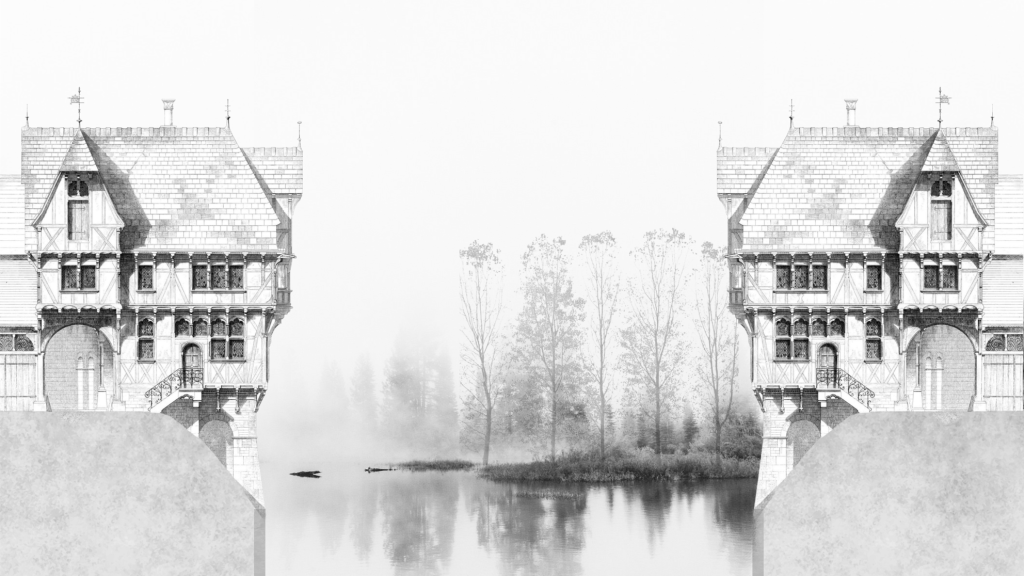
Riparian Quiet Houses are a riverside domestic typology designed to coexist with dynamic water systems while preserving tranquillity, ecological continuity, and long-term habitability. Positioned along a natural river corridor within the green belt, the houses establish a calm and dignified settlement edge, framing the river as a shared ecological spine rather than a privatised amenity. The typology is defined by restraint, dual frontage, and architectural adaptation to seasonal change.
URBAN & LANDSCAPE RELATIONSHIP
The houses form linear bands running parallel to the river, fronting public streets on either side while opening their rear elevations toward the water. This dual orientation ensures that the street remains the primary civic address, maintaining continuity of the public realm, while the river becomes a space of outlook and observation rather than ownership. The riverbanks are left unmanaged, allowing native vegetation and wildlife to flourish without architectural interruption. As a result, the settlement reads as an ordered edge to a living landscape rather than an incursion into it
SECTION & FLOOD ADAPTATION
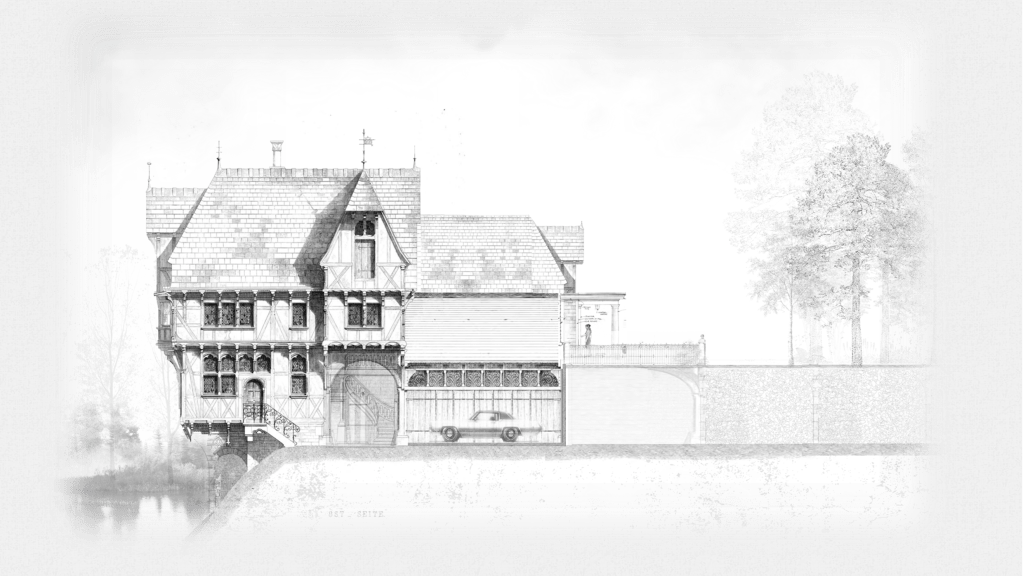
At the sectional level, the typology is characterised by a hydrologically tolerant base. Primary living spaces are elevated above anticipated high-water levels, allowing the river to rise and recede without threatening inhabitation. The lower portions of the buildings are conceived as resilient plinths rather than habitable ground floors, accommodating fluctuation as a normal environmental condition. This approach avoids defensive engineering and instead embeds flood adaptation into the architectural logic of the houses, recalling historic river settlements shaped by experience rather than regulation.
DOMESTIC ORGANISATION & OUTLOOK
Internally, the houses are arranged to prioritise long-duration spaces facing the river. Rear sitting rooms provide quiet places for observation, reading, and rest, allowing residents to engage with seasonal change, wildlife, and light from within the warmth of the home. Street-facing rooms maintain active frontage and social presence, while gardens at street level are deliberately modest in scale. This reduces maintenance demands without diminishing residents’ access to nature, which is experienced visually and atmospherically through the river landscape.
SOCIAL CHARACTER & INHABITATION
The typology is particularly suited to older residents seeking peace, stability, and manageable domestic environments. While private in nature, the houses participate in a broader co-attentive community structure. Residents are invited, but not required, to engage in informal biodiversity monitoring, contributing observations of local wildlife through shared records. This fosters a sense of purpose and stewardship without imposing social obligation, reinforcing a culture of quiet contribution and long-term care.
HERITAGE & SUSTAINABILITY POSITION
Riparian Quiet Houses draw upon historic models of riverside habitation while responding to contemporary environmental realities. Sustainability is expressed not through visible technology, but through restraint, longevity, and respect for natural systems. The typology demonstrates how architecture can accommodate ecological processes, demographic needs, and heritage continuity simultaneously, forming a settlement type that is calm, resilient, and deeply rooted in place.
Riparian Quiet Houses
The Homeowner’s Ecology Book

The Homeowner’s Book is a quiet domestic artefact designed to support long-term inhabitation, ecological awareness, and gentle community participation within the Riparian Quiet Houses.
Each household is provided with a bound book dedicated to the local river landscape and its wildlife. The left-hand pages offer curated information on species commonly encountered along the river corridor, including birds, insects, and seasonal flora. These pages are written in a calm, accessible tone and are intended to encourage observation rather than instruction.
The right-hand pages are deliberately left open for residents to note sightings, dates, or personal reflections. There is no expectation of regular use. Engagement is entirely optional and informal, allowing residents to participate at their own pace and according to their own interests.
Over time, residents may choose to share selected observations within the wider community forum. When collated, these individual notes form a slow, collective record of biodiversity across the development, contributing to an understanding of seasonal change and ecological health grounded in everyday life.
The book is intentionally physical rather than digital. It belongs within the home, often near river-facing sitting rooms, reinforcing stillness, attentiveness, and continuity. In this way, the Homeowner’s Book extends the architectural principles of the Riparian Quiet Houses into daily domestic life, transforming quiet observation into stewardship without obligation.
 Alyssa Denise Walsh