

The Civic Arcade
Implemented as The Skills Arcade
San Francisco Centre as Prototype – Prince’s Quay as Pilot scheme
Abstract
The Skills Arcade
The Skills Arcade proposes a new typology for the adaptive reuse of declining enclosed shopping centres as civic learning infrastructure. The project reframes the spatial logic of the mall, its modular units, internal streets, and circulation, as a framework for the decentralised exchange of skills rather than retail consumption. Independent learning spaces replace shop units, forming a plural, non-institutional educational ecosystem supported by a shared membership model.
Developed through a dual case study of the San Francisco Centre and Princes Quay in Hull, the project tests the transferability of this typology across contrasting economic, cultural, and planning contexts. The research argues that the failure of the enclosed mall is not architectural but programmatic and that its continued spatial relevance enables a shift from consumerism towards civic participation.
The Skills Arcade positions adaptive reuse as a critical architectural strategy for restoring social value, economic dignity, and collective learning within the contemporary city.
OVERVIEW
The Skills Arcade
The Skills Arcade is an architectural proposition for the adaptive reuse of declining enclosed shopping centres as civic learning infrastructure. Rather than attempting to revive retail consumption, the project reframes the mall as a spatial framework for the exchange of skills, knowledge, and cultural practice.
The project is founded on the observation that the architectural logic of the shopping arcade, its modular units, internal streets, visibility, and circulation, remains spatially effective, even as its economic purpose has failed. The Skills Arcade retains this structure but replaces retail units with independently operated learning spaces, each dedicated to the teaching and transmission of a specific skill. These range from craft, repair, and making to financial literacy, performance, digital skills, and civic education.
Each unit functions autonomously within a shared civic envelope, creating a decentralised educational ecosystem rather than a single institutional programme. A collective membership model supports accessibility and cross-disciplinary engagement while allowing individual units to retain control over their pedagogical approach and economic operation. Learning is positioned as visible, participatory, and embedded within everyday urban life.
The project is developed as a typological study, tested through two contrasting case studies: the San Francisco Centre in the United States, representing a widely recognised dead mall condition, and Princes Quay in Hull, United Kingdom, representing a more typical British context of retail obsolescence without abandonment. Together, these sites demonstrate the transferability of the Skills Arcade model across cultural, economic, and planning systems.
Ultimately, The Skills Arcade proposes that the future of the enclosed mall lies not in consumption nor in demolition, but in its transformation into a civic interior where skills are valued as social infrastructure. The project positions architectural reuse as a means of restoring dignity, agency, and collective participation to spaces that once functioned at the heart of urban life.
PROJECT AIMS
The Skills Arcade
- To develop a transferable architectural typology for the reuse of declining enclosed shopping centres The project aims to reconceptualise the enclosed mall as a viable form of civic infrastructure by retaining its spatial logic while fundamentally transforming its programme.
- To reposition skills and lifelong learning as a central civic function of the contemporary city The project seeks to embed practical, cultural, and civic education within everyday urban environments, removing the separation between learning, work, and public life.
- To demonstrate how decentralised, independently operated learning spaces can coexist within a shared architectural framework, The Skills Arcade explores a model in which autonomy, diversity, and accessibility are balanced through architecture rather than institutional control.
- To test the adaptability of the typology across contrasting urban contexts Through a dual case study of the San Francisco Centre and Princes Quay in Hull, the project evaluates how the Skills Arcade responds to differing economic conditions, cultural identities, and planning systems.
- To investigate adaptive reuse as an ethical and socially productive architectural practice The project aims to challenge demolition-led regeneration by demonstrating how existing buildings can be reactivated to support dignity, participation, and community resilience.
- To position architectural design as a mediator between social need and spatial opportunity The project seeks to show how architecture can structure systems of learning, exchange, and belonging, rather than merely accommodating predefined functions.
CONCEPT PHILOSOPHY
The Skills Arcade
The Skills Arcade is founded on the belief that architecture does not merely accommodate social activity, but actively shapes the values a city chooses to uphold. The decline of the enclosed shopping centre reflects not a failure of architecture, but the exhaustion of a consumption-led urban model that once structured civic life. This project proposes that the same spatial framework can be reoriented to support learning, participation, and collective agency.
Historically, arcades functioned as places of exchange, encounter, and apprenticeship, where knowledge and craft were made visible within the public realm. The Skills Arcade draws upon this lineage while rejecting nostalgia, positioning learning as a contemporary civic act embedded within everyday movement through the city. By replacing retail consumption with skill acquisition, the project reframes browsing as curiosity and circulation as intellectual exchange.
Central to the philosophy is decentralisation. Rather than consolidating education within a single institution, the Skills Arcade supports a plurality of independently operated learning spaces, each contributing to a shared civic environment. Architecture becomes the mediator that enables diversity without hierarchy, autonomy without fragmentation, and accessibility without uniformity.
The project also asserts adaptive reuse as an ethical architectural stance. In cities shaped by economic transition, the decision to reuse rather than demolish carries social, cultural, and environmental significance. The Skills Arcade treats existing buildings not as constraints, but as repositories of collective memory capable of supporting new forms of public life.
Ultimately, the Skills Arcade proposes a shift in how urban interiors are valued: from sites of transaction to sites of transmission. It argues that the future of the city lies not in the accumulation of goods, but in the cultivation of shared knowledge, skills, and civic capacity.
SOCIAL UTILITY
Filling the Gap Between Education, Skill, and Civic Life
Contemporary education systems are largely structured around formal institutions, fixed curricula, and age-segmented progression. While universities, colleges, and training providers play a critical role, they often struggle to accommodate lifelong, informal, and practical learning, particularly for adults seeking retraining, skill diversification, or community-based education. As a result, many forms of knowledge, especially craft, repair, cultural, and everyday life skills, remain marginalised or spatially invisible within the city.
The Skills Arcade addresses this gap by providing a civic learning environment that operates outside traditional institutional boundaries. It does not compete with schools, universities, or vocational colleges, but complements them by supporting skills that are too applied, interdisciplinary, or informal to sit comfortably within conventional educational frameworks. Learning is positioned as accessible, modular, and embedded within daily urban movement, rather than confined to formal campuses or scheduled programmes.
By situating education within a reused shopping centre, the project removes barriers commonly associated with learning, including cost, formality, and perceived exclusivity. The visibility of learning spaces within the public realm normalises participation across age groups, backgrounds, and levels of prior attainment, encouraging engagement from those often excluded from institutional education.
The decentralised structure of the Skills Arcade also enables rapid responsiveness to local needs. Independent units can adapt their programmes to changing economic conditions, emerging skills demands, and community interests without reliance on centralised accreditation or lengthy policy reform. This flexibility allows the arcade to function as a living educational infrastructure, evolving alongside the city it serves.
In this way, the project fills a critical gap between formal education and lived experience. It restores learning as a continuous civic practice rather than a time-limited institutional phase, and positions architecture as an active participant in the social transmission of skills, knowledge, and agency.
ADAPTIVE REUSE
Adaptive Reuse Strategy
The Skills Arcade achieves adaptive reuse by working with the existing spatial, structural, and cultural logic of the enclosed shopping centre, rather than attempting to overwrite it with a new architectural identity. The project recognises that the decline of the mall is not a failure of form, but of programme, and therefore prioritises programmatic transformation over structural replacement.
At a spatial level, the project retains the primary circulation routes, atria, and modular shop units that define the mall typology. These elements are reinterpreted as internal civic streets and learning thresholds, allowing the building’s legibility and permeability to remain intact. By reusing existing unit sizes and servicing infrastructure, the project minimises structural intervention while enabling a wide range of learning activities to occupy the space.
Programmatically, retail units are adapted into independently operated skills spaces with minimal internal alteration. This allows for phased occupation, incremental change, and future adaptability without compromising the overall coherence of the building. Larger anchor spaces, such as former cinemas or department stores, are repurposed as shared cultural and performance facilities, extending the building’s civic capacity while preserving its original spatial scale.
Materially, the project favours repair, re-use, and selective upgrading over wholesale replacement. Existing finishes are retained where possible, with interventions focused on improving acoustic performance, environmental comfort, and accessibility. New insertions are intentionally lightweight and reversible, ensuring that the building remains adaptable to future needs without further structural disruption.
Crucially, the project reframes adaptive reuse as a long-term operational strategy rather than a single moment of redevelopment. The Skills Arcade allows the building to evolve through changing skill demands, community use, and economic conditions, extending its lifespan while maintaining relevance. In doing so, the project demonstrates how adaptive reuse can function as a sustainable, socially productive architectural practice, grounded in continuity rather than erasure.
Case Studies
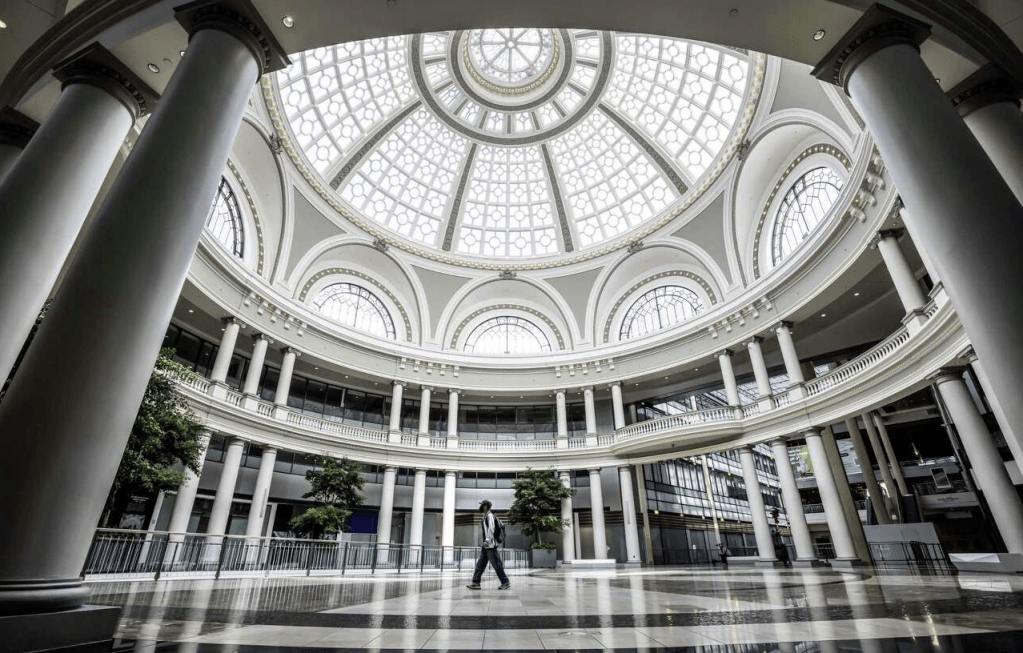
San Francisco Centre
San Francisco, CA, United States
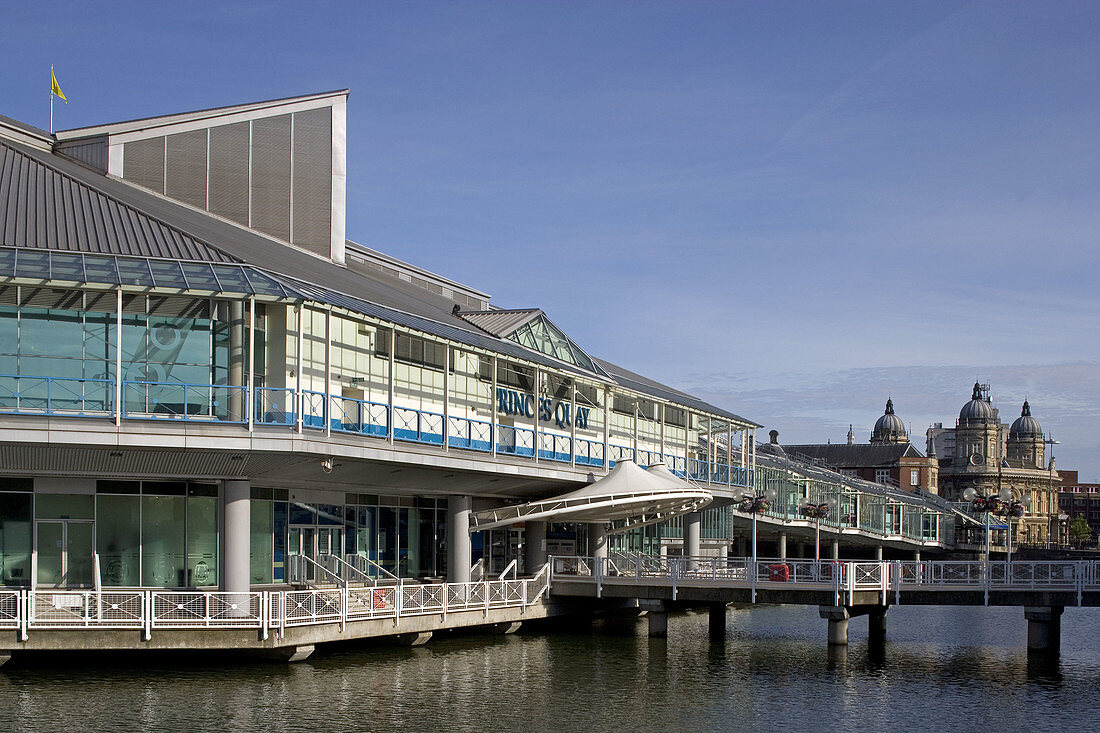
Prince’s Quay
Hull, England, United Kingdom
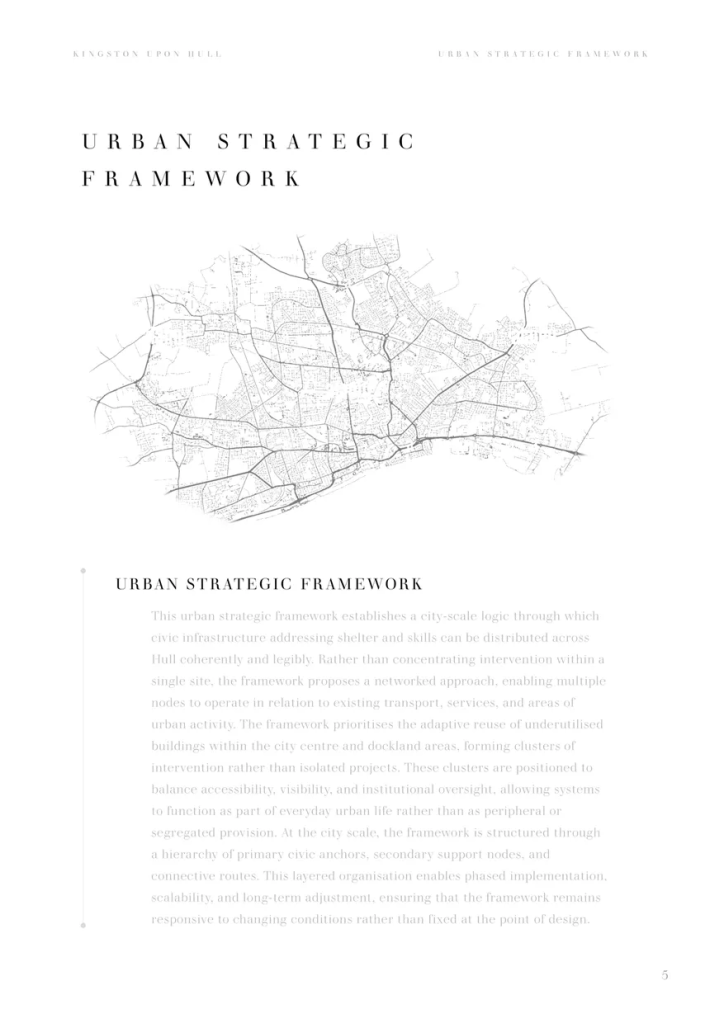
Hull Masterplan
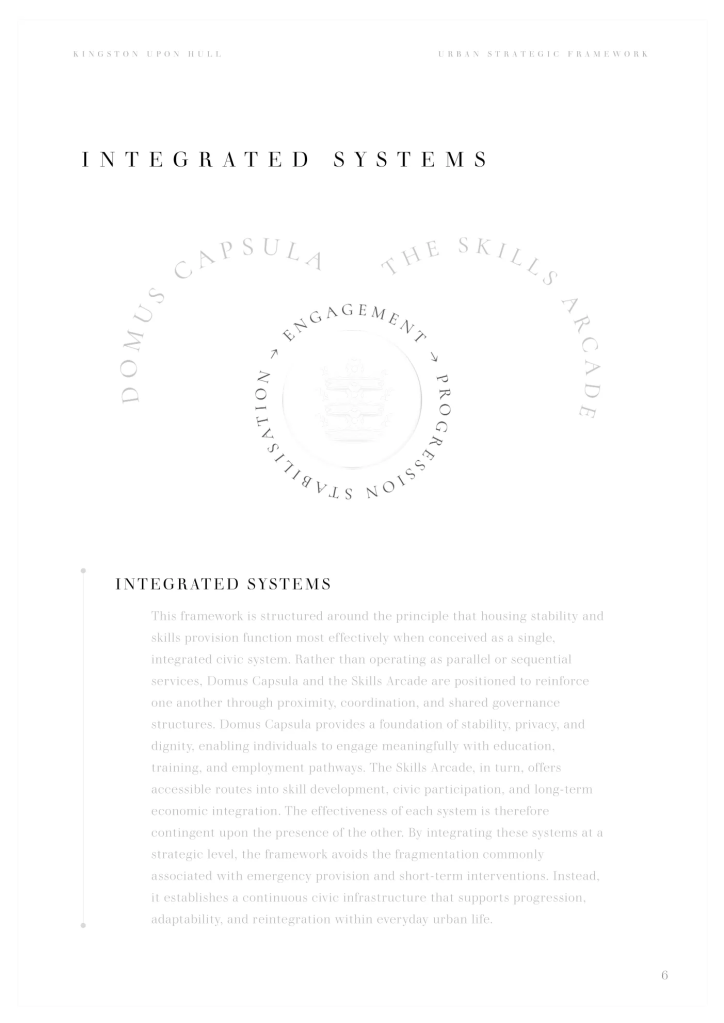
Domus Capsula · Skills Arcade


 Alyssa Denise Walsh